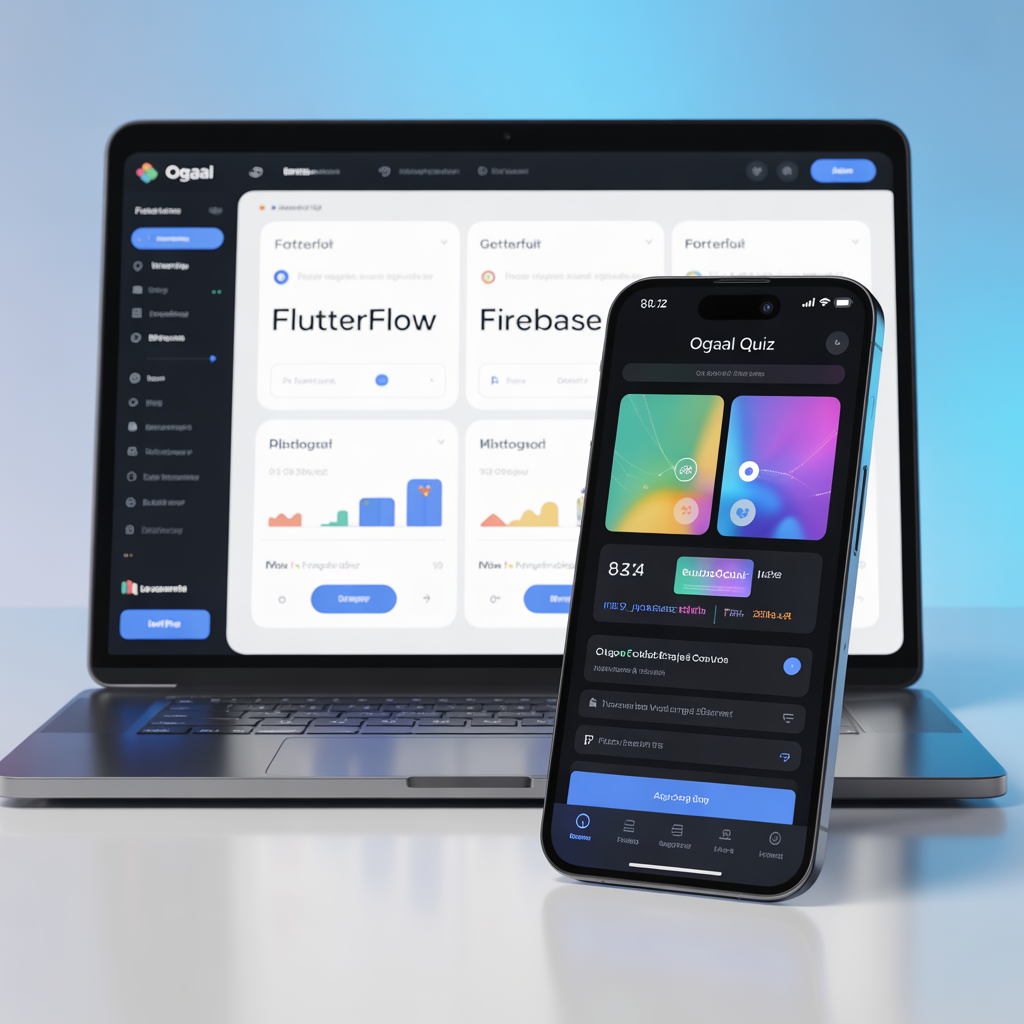
In the rapidly evolving digital landscape of 2026, the demand for localized educational content in Somalia has never been higher. At Bilanly, we identified a gap: the lack of interactive, high-performance quiz applications that cater to the Somali audience while maintaining global technical standards. This led to the creation of Ogaal Quiz.
Building Ogaal Quiz wasn’t just about writing code; it was about leveraging the power of Low-Code and Generative AI to build a scalable, secure, and user-friendly platform in record time. This article provides an in-depth technical walkthrough of how we moved from a concept to a functional application using Atoms.dev for rapid prototyping and FlutterFlow for the final production build.
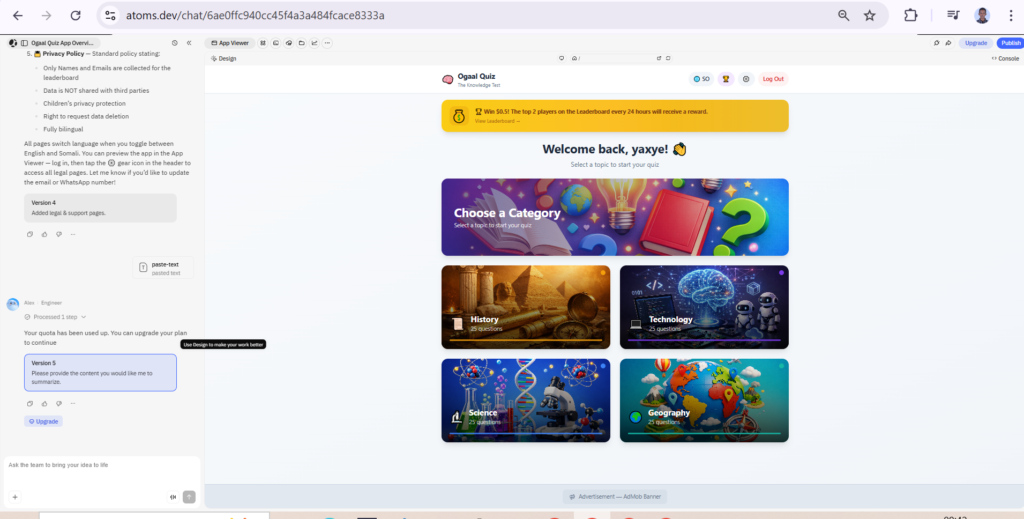
Generating App Logic and UI Components with Atoms.dev AI.
1. The Architecture of Ogaal Quiz
The goal was to create an app that is fast, supports real-time updates, and handles user authentication securely. We chose a hybrid architecture:
Frontend: Built with FlutterFlow for its superior UI/UX capabilities and cross-platform (Android/iOS) support.
Backend: Powered by Firebase for real-time database management and authentication.
Prototyping & Logic Generation: Atoms.dev served as the AI-engine to generate initial atoms (components) and logic structures.
The most time-consuming part of app development used to be the “Bootstrap” phase. With Atoms.dev, we skipped the manual setup.
Generative UI: We used natural language prompts to generate the core screens: the Splash Screen, Login Interface, and the Quiz Dashboard.
Prompt Engineering: By feeding the AI specific requirements—such as “Create a leaderboard UI that ranks users based on high scores with a Somali-flag aesthetic”—we received clean, functional components in seconds.
Credit Management: Since we were scaling multiple features, we strategically managed development by utilizing multiple Gmail accounts to maximize the utility of the Atoms.dev platform, a common “Pro-tip” for lean developers in 2026.
Once the core logic was generated, we migrated the project to FlutterFlow for professional-grade refining.
Visual Building: We utilized FlutterFlow’s drag-and-drop interface to refine the animations between quiz questions.
Responsive Design: In 2026, Somali users access apps from a variety of devices, from low-end smartphones to high-end tablets. We used FlutterFlow’s “Adaptive Layouts” to ensure a seamless experience across all screen sizes.
Leaderboard Logic: We integrated a dynamic leaderboard that queries Firebase in real-time. This allows users to see their ranking globally as soon as they finish a quiz.
4. Authentication and User Privacy
In 2026, data privacy is a non-negotiable requirement for AdSense approval and user trust. For Ogaal Quiz, we implemented a strict “Privacy by Design” policy.
Data Collection: We only collect essential information: Name and Email. This ensures compliance with global data protection regulations (GDPR) and local Somali privacy expectations.
Firebase Auth: We used Firebase Authentication to provide a secure login flow, preventing unauthorized access to user data.
5. Monetization Strategy: AdMob Integration
A successful app must be sustainable. For Ogaal Quiz, we integrated Google AdMob to generate revenue through non-intrusive ad placements.
Banners vs. Interstitials: We placed banner ads at the bottom of the home screen and utilized interstitial ads only after a user completes a 10-question set. This preserves the user experience while maximizing impressions.
Global Distribution: Before scaling to the Google Play Store, we targeted the Amazon Appstore to reach a broader international audience, diversifying our revenue streams.
6. Challenges and Technical Solutions
Building Ogaal Quiz wasn’t without its hurdles.
Real-time Latency: Initially, the leaderboard had a 2-second delay. We optimized this by using “Firebase Indexing,” which allowed the app to sort thousands of scores in milliseconds.
Audio Integration: For educational apps, sound is key. We integrated optimized audio files that trigger upon correct or incorrect answers, enhancing the gamification element.
7. The Future of Ogaal Quiz
As we look toward the remainder of 2026, we plan to integrate AI-Generated Questions. This will allow the app to create unique quiz sets for every user based on their past performance, ensuring that the learning process never becomes repetitive.
Conclusion: Why Low-Code is the Winner
Ogaal Quiz is a testament to how far technology has come. What would have taken a team of developers months to build five years ago was accomplished by a small, focused team using the right AI tools. For the entrepreneurs reading this on Bilanly, the message is clear: The tools are there. The logic is accessible. The only thing missing is your execution.