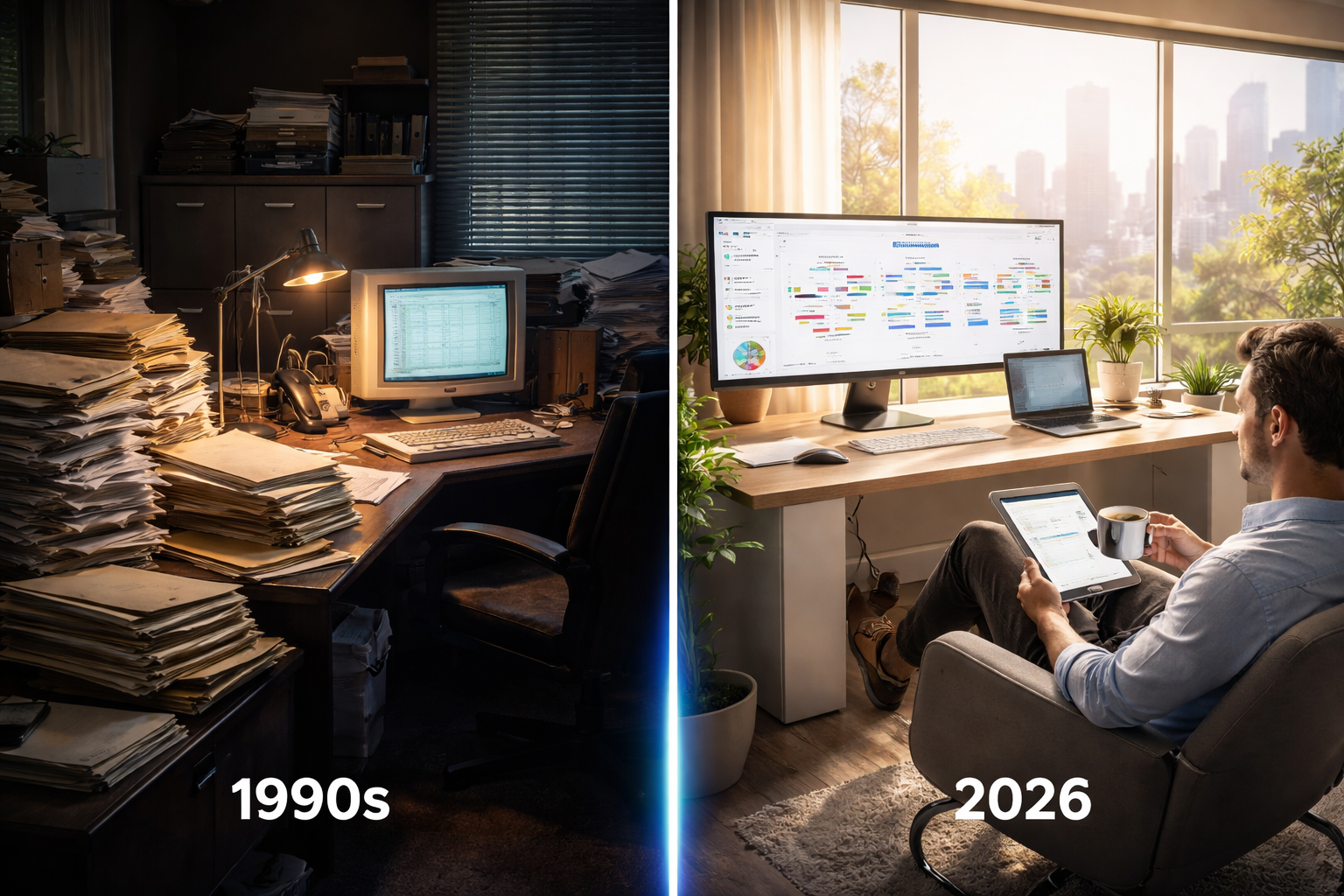
As we move through 2026, the traditional office is no longer a physical destination—it’s a digital state of mind. The “9-to-5” grind, once the backbone of global commerce, has been officially replaced by a fluid, decentralized, and AI-augmented reality. We are no longer talking about “digital transformation” as a future goal; we are living in the Era of AI Integration.
At Bilanly, we’ve observed that the most successful professionals in 2026 aren’t necessarily those who code the fastest or work the longest hours. Instead, the winners are those who can effectively collaborate with AI to amplify their human potential. This guide explores the shifting tectonic plates of the global job market and how you can position yourself to thrive.
1. The Rise of Human-AI Hybrid Teams
In 2026, the “lone wolf” worker is a rarity. Professional tasks are now performed by Hybrid Teams where humans and AI agents work in tandem. Companies have shifted their hiring focus from “basic technical proficiency” to “AI Fluency.”
The Strategists (Humans): You define the “Why” and the “What.” You provide the vision, the ethics, and the emotional intelligence that a machine lacks.
The Executors (AI): Agents handle the “How” and the “When.” They process massive datasets, generate initial drafts, and automate repetitive workflows.
If you can bridge the gap between human intent and AI execution, you are becoming the most valuable asset in the modern economy.
2. Remote Work 2.0: Beyond Zoom and Slack
Remote work has evolved past the “emergency phase” of the early 2020s and settled into a sophisticated, permanent structure. In 2026, the focus has shifted from where you work to how you collaborate.
Asynchronous Mastery: With global teams working across 24 time zones—from Bosaso to San Francisco—the ability to communicate clearly through writing and recorded video (like Loom) has become more important than sitting in live meetings.
Spatial Computing & VR: We are seeing the first mainstream wave of Spatial Computing. Virtual offices are no longer gimmicks; they are functional spaces where remote teams brainstorm around 3D models and digital whiteboards in a shared environment.
The Outcome-Based Economy: Employers no longer pay for “hours logged.” They pay for “Impact Achieved.” This gives freedom to workers who can complete their tasks with high efficiency using AI tools.
3. The Death of Entry-Level “Busy Work”
One of the most significant shifts in 2026 is the near-total automation of entry-level administrative tasks. Data entry, basic bookkeeping, and initial customer support are now handled by Agentic AI systems.
This presents a challenge for young professionals: The “career ladder” has lost its bottom rungs. To succeed as a junior in 2026, you must leapfrog over basic execution and prove your value in Creative Problem Solving and Critical Thinking. You are no longer learning the “ropes” of manual tasks; you are learning to manage the systems that do those tasks.
4. High-Income Skills for 2026: What to Learn Now
The skill set required to earn a high income has shifted significantly. Here is what we recommend at Bilanly:
AI Orchestration: The ability to communicate precisely with Large Language Models (LLMs) to get elite-level results.
Data Storytelling: AI can generate charts, but it cannot explain what those charts mean for the future of a specific business.
Digital Ethics & Governance: As AI makes more decisions, companies need humans who ensure those decisions are fair, legal, and aligned with human values.
Soft Skills (The “Hard” Skills of 2026): Empathy, negotiation, conflict resolution, and leadership. These are the only things AI cannot replicate.
5. The “Fractional” Professional & The H-Certified Premium
A major trend in 2026 is the rise of the “Fractional Leader.” Instead of working for one company, experts work for 3 or 4 companies simultaneously. This provides income security and diversity of experience.
Furthermore, we are seeing a “Human-Only” movement. There is a premium on anything that can prove it was created without AI. From investigative journalism to luxury craftsmanship, the “human touch” has become a status symbol.
6. Global Competition: Talent Without Borders
For the first time in history, a worker in Bosaso, Somalia, can compete for the same high-paying role as someone in London. The global talent pool is truly flat. While this increases competition, it also increases opportunity. If you have the skills and a stable internet connection, the global economy is your playground.
Conclusion: Embracing the Unknown
The future of work in 2026 is both exciting and intimidating. It demands a level of adaptability that previous generations never had to face. However, for those willing to learn, experiment, and embrace the power of AI, the opportunities are limitless.
Don’t fear the machine; become the person who knows how to drive it. Your career in 2026 isn’t about surviving the change—it’s about leading it.