
Introduction: Why Your Business Data is Your Biggest Asset
In the hyper-competitive digital landscape of 2026, the difference between a startup that thrives and one that fails is how they manage their most valuable asset: Customer Data. At Bilanly, we have observed that many emerging businesses struggle with fragmented information, losing potential revenue in the cracks of spreadsheets and manual notes. A Customer Relationship Management (CRM) system is no longer just a digital address book; it is the central nervous system of your entire business operation.
As we navigate through 2026, the integration of AI within CRM platforms has transformed them into proactive advisors that don’t just store data but predict future sales trends. This guide provides a comprehensive technical and strategic walkthrough of how to leverage modern CRM software to scale your business from a small startup to a market leader.
1. The Architecture of a Modern CRM in 2026
To understand why a CRM is essential for PartnerStack-grade approval, we must look at its core architecture. Modern systems are built on three fundamental pillars:
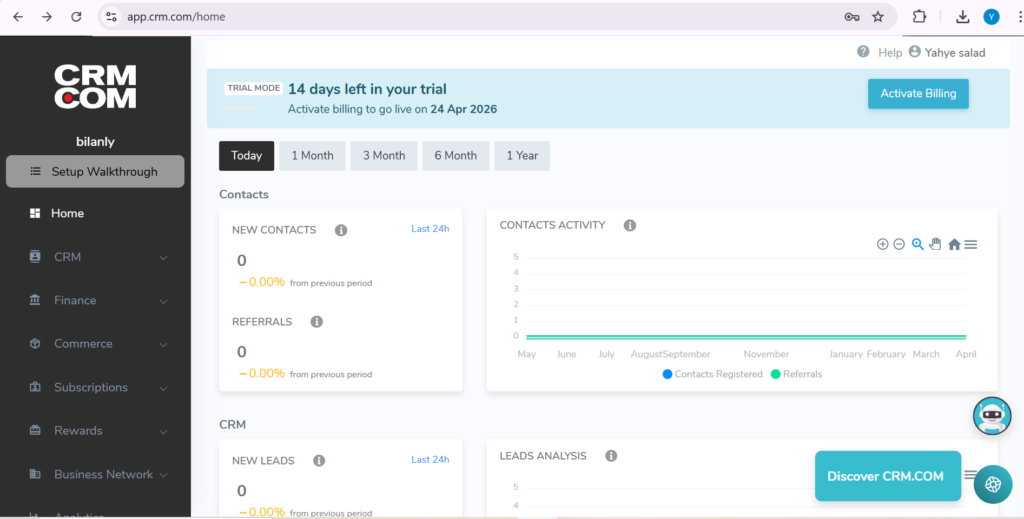
Caption: The Bilanly CRM Dashboard: A streamlined and intuitive interface for managing early-stage startup leads in 2026.
Detailed Description: The screenshot above showcases the internal CRM.COM dashboard specifically configured for the Bilanly ecosystem. As illustrated, the platform offers a centralized view for monitoring “New Contacts,” tracking “Referral” growth, and conducting real-time “Leads Analysis.” Even during the initial implementation and trial phase, this setup allows us to architect a robust sales pipeline and automate contact activity tracking well before the full commercial rollout scheduled for April 24, 2026. This visual clarity is essential for any modern startup looking to move away from fragmented data toward a unified growth strategy.
Bilanly’s Professional Insight: “For emerging tech startups, the initial trial phase of a CRM is not just a free period—it is a critical ‘Sandbox’ environment. We highly recommend using this time to map your existing business workflows and integrate your lead-generation tools. Mastering the dashboard logic early ensures that once your billing goes live, your infrastructure is already optimized for maximum ROI and seamless customer acquisition.”
A. Automation (The Efficiency Engine)
Manual tasks are the silent killers of productivity. A 2026-grade CRM automates the entire “Lead-to-Cash” journey. From the moment a visitor fills out a form on your website to the final invoice, every step is triggered automatically. This ensures that your sales team spends their time talking to customers, not filling out forms.
B. Analytics (The Insight Engine)
Data without interpretation is noise. Modern CRMs provide real-time dashboards that visualize your Sales Pipeline. You can see exactly where a deal is stuck, the average “Close Rate” of your team, and the “Customer Acquisition Cost” (CAC) at a glance.
C. Artificial Intelligence (The Predictive Engine)
The biggest shift in 2026 is Predictive Lead Scoring. AI analyzes your historical data to tell you which leads are most likely to convert. Instead of calling everyone, your team focuses on the “Hot Leads,” increasing efficiency by over 400%.
2. Breaking Down the Benefits: Why Manual Data Entry is Dead
One of the most significant barriers to scaling is the “Data Silo”—where information is trapped in different departments. A CRM breaks these silos by creating a Single Source of Truth.
- Centralized Communication: Every email, phone call, and meeting is logged in one place. If a sales agent leaves the company, the next person can pick up exactly where they left off without missing a beat.
- Seamless Integrations: The top CRM platforms in the PartnerStack ecosystem (like Salesforce, HubSpot, or Pipedrive) integrate directly with your email (Gmail/Outlook), your project management tools (Monday.com), and even your communication apps (Slack/Loom).
- Enhanced Collaboration: Marketing teams can see which campaigns are generating the highest quality leads, while support teams can see a customer’s entire history before answering a ticket.
3. Personalization at Scale: The 2026 Competitive Advantage
Customers in 2026 are overwhelmed with generic advertisements. To win, your business must offer Personalization at Scale. This is only possible through “Audience Segmentation” within your CRM.
By categorizing your customers based on their behavior—such as what products they viewed or which emails they opened—you can send highly targeted messages. For example, if a user on Bilanly reads about Cloud Computing, the CRM can automatically trigger a personalized email offering a discount on a Cloud Security tool. This level of relevance is what turns a “Visitor” into a “Loyal Customer.”
4. Implementation Strategy: How to Get Started
Moving to a CRM can feel overwhelming, but it follows a simple four-step process:
- Audit Your Current Process: Map out how a lead currently moves through your business.
- Clean Your Data: Remove duplicate contacts and outdated information.
- Define Your Pipeline Stages: Clearly mark the steps (e.g., Prospecting, Negotiation, Closing).
- Train Your Team: A CRM is only as good as the data entered into it. Building a “CRM-First” culture is essential for success.
5. Conclusion: Investing in Your Future
Scaling a startup in 2026 without a CRM is like trying to navigate the ocean without a compass. It might work for a while, but eventually, you will lose your way. By investing in a robust CRM today, you are not just buying software; you are building an infrastructure that supports infinite growth, ensures data security, and maximizes your team’s potential.